
Chimney sweep and inspection in Revere, MA
Revere has the newest housing stock on our northern run. The median house here went up in 1957, the median apartment in 1976 — a generation later than Everett or Malden. That changes what a chimney is for. In a postwar Revere house the brick stack was not built for a hearth but to carry the exhaust of an oil burner and a water heater. Plenty of them have never had a fire in them at all, and they stand in salt air a few streets from the Atlantic.
- Free inspection
- Written quote before we start
- Photos per flue
- No deposit
Why Revere is different
A heating flue, not a fireplace.
Most of Revere was built out after the war, and the building habit of that period was a plain masonry chimney lined with clay tile, sized for the oil-fired boiler it was going to serve. Decorative fireplaces turn up in West Revere and along the Boulevard, but across the city they are the exception. The chimney is mechanical equipment.
So the usual Revere call is not a smoky fire. It is a boiler behaving oddly, a smell of combustion in a basement, a damp patch on a chimney breast, or an inspector who wrote “chimney needs evaluation” before a sale. None of those are creosote problems.
The thing we look for first
The last four feet, and the salt.
A chimney here spends its life in damp, salty air. Salt keeps masonry wet longer than rain alone does, and wet masonry in a Massachusetts winter freezes and loses its grip. The damage concentrates where nobody can see it from the sidewalk: the concrete crown, and the three or four courses of brick just below it.
It falls inwards
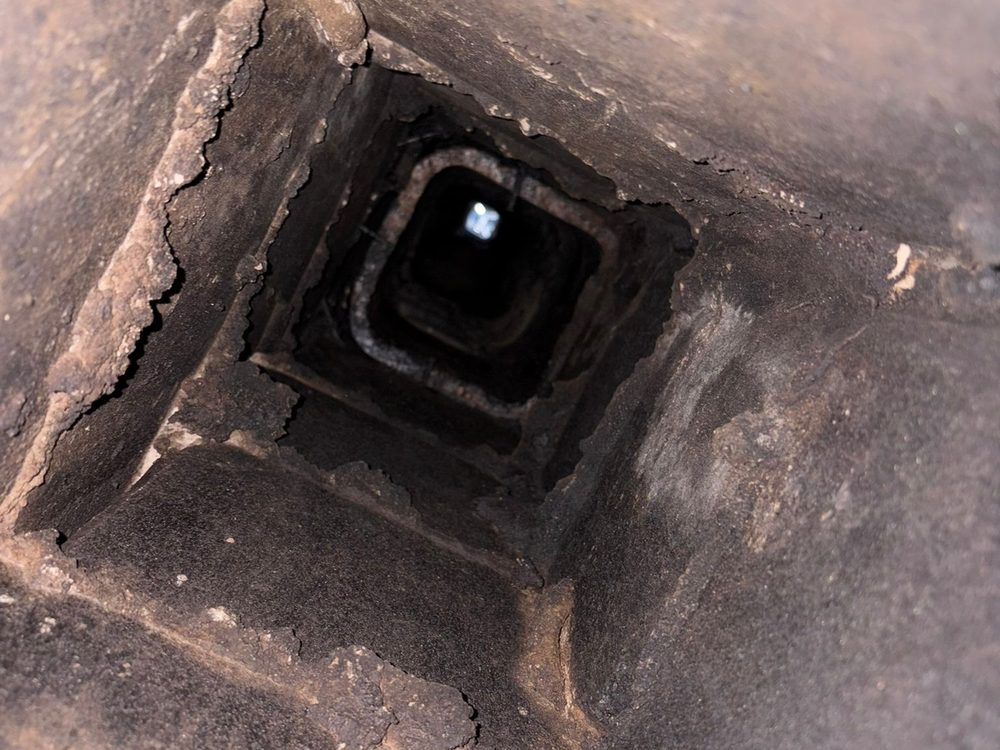
When the crown cracks and the top courses spall, the pieces do not land on the roof. They drop down the inside of the flue and pile up on the smoke shelf or against the clean-out door at the base. We have found flues half closed off by their own brick.
Why it goes unnoticed
Nothing about it is visible or audible from inside the house, and the appliance will keep running for a long time on a partly blocked flue. The first sign is usually the boiler short-cycling or a water stain appearing on an upstairs wall, long after the masonry gave out.
If the house changed fuel
Oil out, gas in, same flue.
Revere ran on oil for decades and a great deal of it has gone over to gas one house at a time. About 19.3% of houses and condos here are still on oil, which means roughly four in five have switched at some point — usually without anyone touching the chimney.
A flue built for an oil burner is wider than a gas appliance needs. The smaller, cooler exhaust climbs slowly and leaves its moisture on the clay tile instead of carrying it out the top, and that water sits in the mortar joints year after year. It is the most common thing we write up in a converted Revere house.
If you own the building
Three quarters of Revere is not a detached house.
Only about 25.4% of Revere’s housing is a detached single-family home. 23.6% sits in two-unit buildings, 11.5% in threes and fours, and 30.8% in buildings of five units or more — the largest apartment share of any town on this run. About 54% of occupied homes are rented.
So the caller is often an owner who needs to know which flue serves which unit and which are no longer connected to anything. We count the live flues and photograph them separately, labelled by unit where the stack is shared.
What it costs
Free to look. Quoted in writing before anything else.
Inspection
Freewith photographs
Each live flue, plus the cap, the crown and the flashing. If everything is clear and sound, we tell you that and there is nothing to pay.
- Sweep, per fluequoted on site
- Cap supplied and fittedquoted on site
- Crown and flashing workquoted on site
Why there is no number here
A single oil flue in a 1957 ranch and a shared stack behind a Shirley Avenue three-decker are different jobs, and a phone call cannot tell us which one you have. Any price quoted before the stack has been seen would have to be corrected at your door.
If anyone prices your chimney sight unseen, that is worth a second thought.
What the inspection covers
Count, look, show, quote.
Count the live flues
Which appliance uses which flue, which unit it belongs to, and which flues are no longer connected to anything.
Look inside each one
Photographed, so you see the inside of your own flue instead of taking our word for it.
The crown, the cap and the flashing
On a coastal stack this is where the trouble starts, so it is part of every visit here rather than an extra.
A written quote
Itemised per flue, before anyone starts. If the problem turns out to be the appliance and not the flue, we say so. We do not repair or service boilers, furnaces or water heaters.
Questions
What Revere callers ask.
We have no fireplace at all. Why would we need a chimney sweep?
Because in Revere the chimney is usually there for the heating, not for a fire. A postwar house was built with a masonry flue to carry the exhaust of an oil burner and a water heater. That flue still has a job even though nothing has ever been burned in a hearth. What collects in it is not creosote but soot, rust scale and pieces of its own brick and mortar.
Does living near the water actually change anything?
On the top three or four feet of the stack, yes. Salt carried in off the beach keeps masonry damp and works into the mortar, and then the freeze and thaw cycle finishes the job. The crown cracks, the top courses of brick spall, and what comes off falls down inside the flue rather than onto the roof. That is why we photograph the crown and the cap on every visit here, not only the inside.
Our oil burner was replaced with gas years ago. Is the chimney still right for it?
That is worth looking at. A flue sized for an oil burner is larger than a gas appliance needs, so the exhaust rises slowly and cools on the way up, and moisture condenses on the clay tile instead of leaving. Over years that attacks the mortar joints from the inside. It is one of the first things we check in a converted house.
We still heat with oil. Is that a different job?
Yes. About 19.3% of Revere houses and condos still heat with oil. Oil soot is fine and acidic and settles differently from wood ash, so the base of the flue and the clean-out door need a closer look than a gas flue does.
I rent out the other units. What do I get to show tenants?
Dated photographs of each live flue, the cap, the crown and the flashing, labelled by unit where the stack is shared. They are yours whether or not you have any work done, and the quote that follows is itemised per flue so you can see which floor each line belongs to.
Where we go in Revere
The neighbourhoods, and when we can come.
Beachmont · Point of Pines · Oak Island · Revere Beach Boulevard · Shirley Avenue · Broadway · Revere Street · West Revere
Crews reach Revere off Route 1A, Route 60 and Route 16, the same run that covers Chelsea, Everett, Malden, Saugus and Lynn, with appointments starting the next working day.
Book it
The inspection is free either way.
Tell us the address and we will find the closest crew. Leave your number on the booking form and we call you back with a window, or call (617) 812-5319 now.
Also in Revere
The other two services.
Air ducts and dryer vents in Revere · Dryer vents — $99 flat · Chimneys across MA, CT & RI · Chimney sweep in Everett · Chimney sweep in Malden · Chimney sweep in Lynn
Malden · Medford · Everett · Chelsea · Somerville · Lynn · Saugus · Boston · Cambridge · Quincy · Newton
Book a visit
Request a callback.
Leave your number and we call you back with a window. If there has never been a fire in it, that is normal here — the flue is there for the heating. No deposit, and the inspection is free whether or not you go ahead.